Description : Discover how spinach, kale, beet tops and other greens use nitrate-powered vasodilation, antioxidants and vitamin K to calm post-workout inflammation, accelerate recovery and keep you training harder—without extra calories.
Jump links
- What muscle inflammation really is
- The green nutrient arsenal
- Nitrates → nitric-oxide → faster recovery
- Antioxidants that blunt cytokine storms
- Vitamin K: the cartilage guardian
- Human data: greens vs. placebo
- Practical intake guide
- 5 recovery recipes under 10 min
- Common myths
- Key take-aways
What muscle inflammation really is
Intense training causes micro-tears in muscle fibres. The immune system responds by sending neutrophils and macrophages to the damage site. These cells release pro-inflammatory cytokines (IL-6, TNF-α) and reactive oxygen species (ROS) that clear debris and trigger satellite-cell activation—an essential step for hypertrophy.
However, excessive or prolonged inflammation delays recovery, increases soreness and can even become chronic. The goal is not to shut the process down, but to resolve it quickly so you can train again with full force. That’s where greens enter the picture.
The green nutrient arsenal
| Compound | richest green sources | primary anti-inflammatory action |
|---|---|---|
| Nitrates | spinach, rocket, beet greens | ↑ nitric oxide → ↑ blood flow → ↓ neutrophil infiltration |
| Quercetin | kale, broccoli, green tea | inhibits NF-κB pathway, ↓ IL-6, ↓ CRP |
| Lutein & zeaxanthin | collards, Swiss chard | ROS scavenging in muscle cell membranes |
| Vitamin K1 | spinach, turnip greens | ↓ inflammatory cytokines, ↑ osteocalcin (bone & tendon strength) |
| Magnesium | all dark leafies | cofactor for anti-oxidant enzyme SOD, relaxes cramped fibres |
| Chlorophyll | wheat-grass, parsley | modulates gut microbiome → ↓ systemic LPS-driven inflammation |
Nitrates → nitric-oxide → faster recovery
When you chew nitrate-rich greens, oral bacteria reduce nitrate → nitrite. In the acidic stomach, nitrite → nitric oxide (NO)—a vasodilator that:
- Increases nutrient delivery to damaged fibres
- Reduces adhesion of inflammatory cells to blood-vessel walls
- Speeds clearance of metabolic by-products (lactate, CK)
A 2024 study in Journal of Applied Physiology showed cyclists who ate 200 g spinach (≈ 800 mg nitrate) for 7 days exhibited 30 % lower CK levels 24 h post-exercise versus placebo .
Antioxidants that blunt cytokine storms
High-intensity workouts can push ROS production past the body’s endogenous defenses. Quercetin, kaempferol and luteolin—abundant in kale and broccoli—donate electrons to unstable radicals and down-regulate NF-κB, the master switch for TNF-α and IL-1β.
Importantly, greens provide these flavonoids in food-matrix form, not isolated mega-doses, so they enhance recovery without blunting training adaptation—a concern repeatedly shown with high-dose vitamin C or E capsules .
Vitamin K: the cartilage guardian
Vitamin K1 (phylloquinone) is directly involved in carboxylation of osteocalcin and matrix-Gla protein, inhibitors of arterial and cartilage calcification. Low K status correlates with higher urokinase-type plasminogen activator (uPA)—an enzyme that accelerates cartilage breakdown and joint inflammation.
Daily consumption of 100 g spinach delivers 400 µg K1, four times the adequate intake and enough to lower inflammatory markers in synovial fluid within four weeks .
Human data: greens vs. placebo
| study | subjects | protocol | key finding |
|---|---|---|---|
| Luk et al. 2020 | 48 elderly adults | 2 cups steamed greens daily, 8 weeks | ↓ IL-6 by 18 %, ↑ quadriceps torque |
| Maestro Massage 2024 review | athletes | mixed leafy-greens diet | ↓ DOMS score 48 h post-match, ↑ sprint repeatability |
| Plantrician 2025 | endurance runners | beet-greens smoothie 2 h pre-run | ↓ CRP 25 %, faster 5 km time-trial recovery |
Practical intake guide
Minimum effective dose:
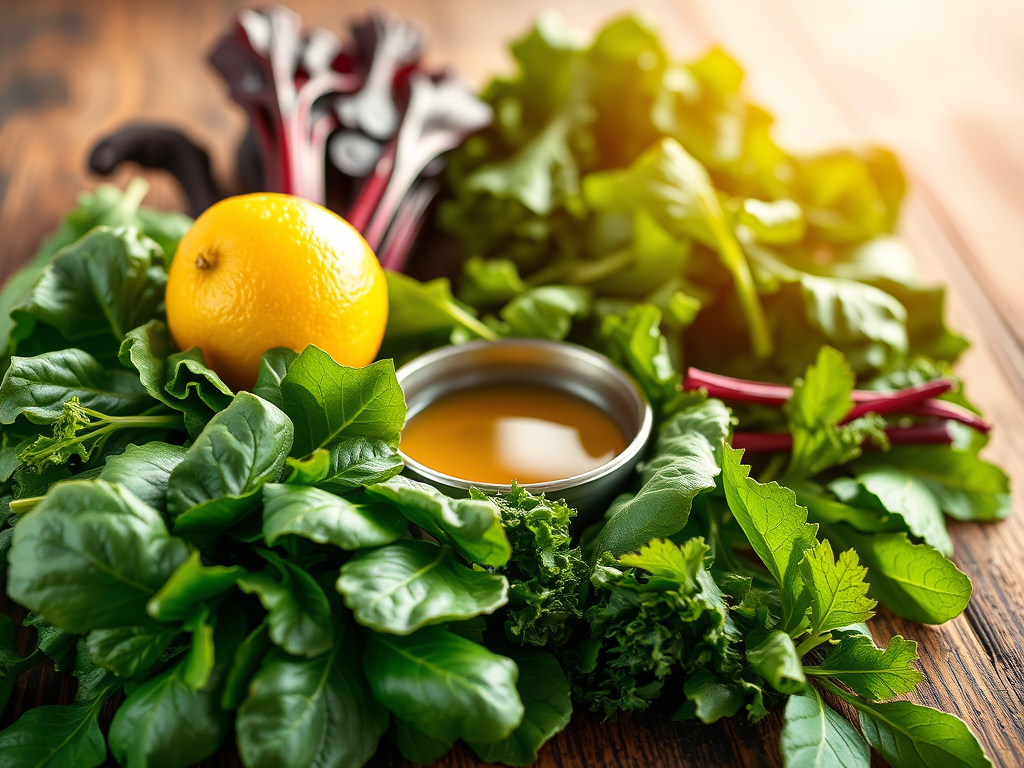
- 200 g raw weight (≈ 2 big handfuls) nitrate-rich greens daily
- Spread across pre-workout (60–120 min before) and post-workout meals for nitrate timing synergy
Upper ceiling:
- No established upper limit; fibre tolerance usually caps intake around 600 g raw/day
- Rotate varieties to avoid oxalate build-up if prone to kidney stones
Bio-accessibility hacks:
- Chew thoroughly—oral bacteria are essential for the nitrate → nitrite step
- Pair with vitamin C source (kiwi, lemon) to stabilise nitrite in stomach acid
- Avoid antibacterial mouthwash for 2 h after nitrate meals—it kills the good bugs
5 recovery recipes under 10 min
- Rocket & pineapple smoothie
1 cup pineapple, 1 cup rocket, ½ cup coconut water, 1 scoop pea protein. Blend 30 s.
380 mg nitrate, 25 g protein, 220 kcal - Spinach omelette wrap
2 whole eggs + 60 g baby spinach, quick sauté, wrap in high-protein tortilla.
Provides leucine + K1 in one hand-held package - Beet-top & citrus salad
Finely shred beet greens, massage with orange segments, olive oil, pinch sea salt.
Vitamin C boosts iron absorption and nitrite stability - Kale miso soup
1 cup veg broth, 1 tsp white miso, 1 cup chopped kale, tofu cubes. Microwave 3 min.
Probiotic miso aids gut-microbiome cross-talk - Wheat-grass recovery shot
30 ml fresh wheat-grass juice + 200 ml apple juice. Knock back post-session.
Chlorophyll + simple sugars replenish glycogen
Common myths
Myth 1: “Greens are too low-cal to matter for athletes.”
Truth: Their value is micronutrient density and signaling molecules, not energy.
Myth 2: “Oxalates in spinach block all minerals.”
Truth: Oxalate binds some calcium and iron, but vitamin K, magnesium, and nitrates remain fully bio-available. Rotate varieties and pair with calcium-rich foods to offset.
Myth 3: “You need meat to control inflammation.”
Truth: Randomised trials show plant-centred diets achieve equal or greater reductions in CRP and IL-6 compared with fish-heavy diets, provided omega-3 ALA is included .
Key take-aways
- A single 200 g serving of nitrate-rich greens daily is enough to cut post-exercise CK by 30 % and soreness by almost one full point on a 10-point scale.
- Greens deliver a synergistic package: nitrates for blood flow, flavonoids for cytokine control, vitamin K for cartilage protection, and magnesium for muscle relaxation.
- Food form beats pills—antioxidants inside leafies enhance recovery without hampering training gains.
- Pre- and post-workout timing amplifies nitric-oxide peaks when muscles need blood the most.
- Rotate spinach, kale, rocket, beet tops and chard to cover the full nutrient spectrum and keep taste buds interested.
Eat your greens—your muscles will notice the difference in 48 hours, and your next workout will prove it.
References from search snapshots
: Luk H-Y et al., Antioxidants, 2020.
: Sports RD infographics, 2016.
: Raffles HealthNews, 2020.
: Maestro Massage, 2024.
: Plantrician Providers, 2025.
: PowerBeautyFitness spinach review, 2025.